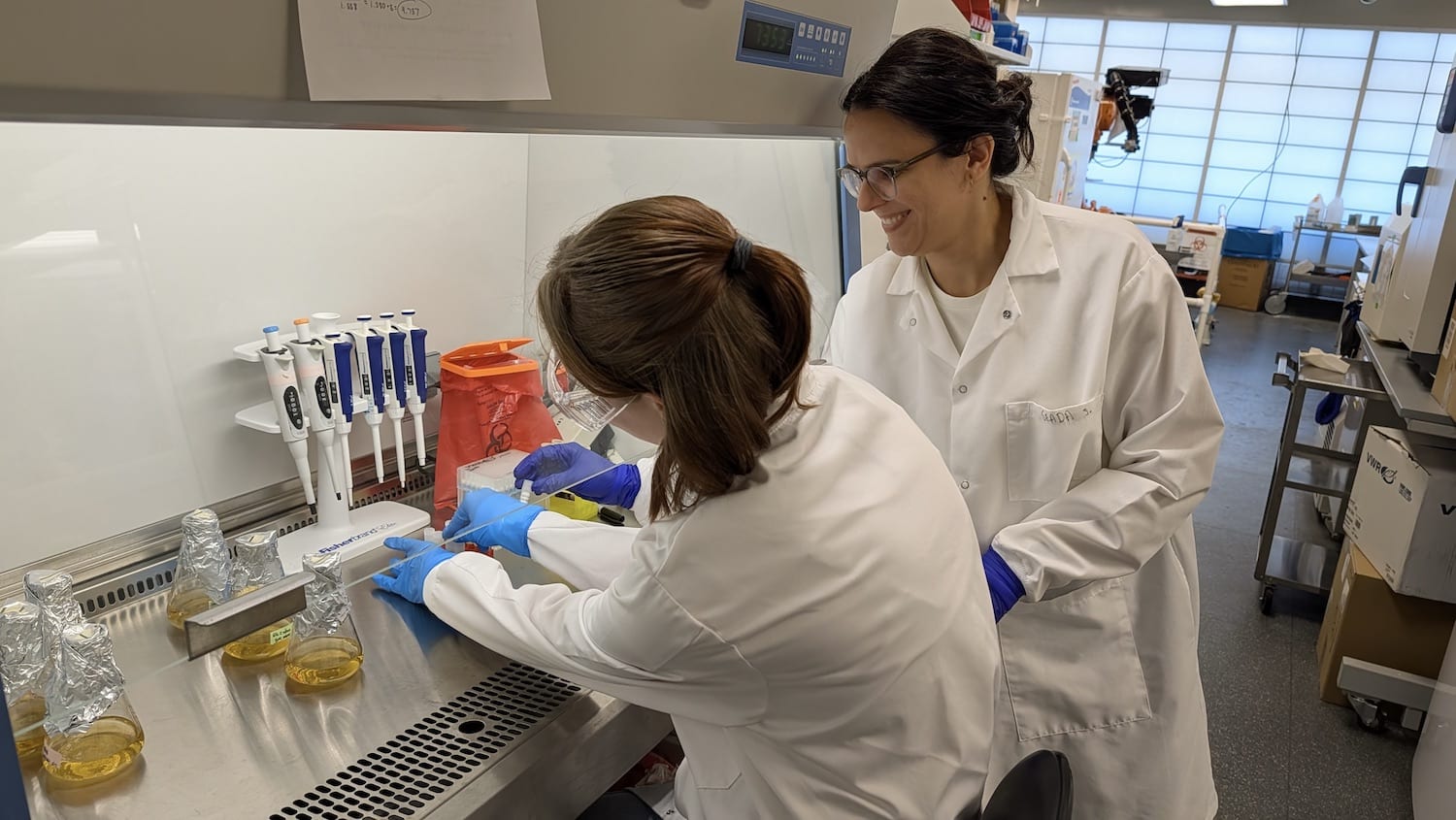
Michelle Schroeder-Moreno: Growing a New Workforce

The Bezos Center for Sustainable Protein executive leadership team consists of five leaders working toward the center’s goal to research, create and translate new technologies for manufacturing environmentally friendly, healthy and affordable protein products.
Co-Directors Bill Aimutis and Rohan Shirwaiker secured the Bezos Earth Fund grant in 2024 and have led the center’s growth since conception.
Three other NC State University professionals, each holding multiple roles across the institution, also contribute their expertise to advancing the center’s three pillars – research and development, workforce development, and community outreach and engagement.
Meet Michelle Schroeder-Moreno, the Bezos Center’s associate director for workforce development.
A Focus on Sustainability
Sustainable agriculture is at the heart of Schroeder-Moreno’s leadership at NC State, so her participation with the Bezos Center makes good sense.
Schroeder-Moreno is director of the Center for Environmental Farming Systems (CEFS) and an agroecology professor in the Department of Horticulture Science in the College of Agriculture and Life Sciences (CALS).
She’s involved with sustainability via her work at CEFS and provides leadership to various sustainable agriculture and food systems research, extension and education programs across the state.
“As a way to inspire and train future food system leaders, I started NC State’s Agroecology and Sustainable Food Systems interdisciplinary B.S. degree program and the associated Agroecology Education Farm over 15 years ago, developing its courses and programs,” says Schroeder-Moreno.
She points to this experience as why Aimutis and Shirwaiker invited her into the original Bezos Earth Fund proposal discussions.
“Since 1999, we have developed a variety of successful CEFS internship programs, so I had demonstrated experience in the workforce development initiatives they wanted to build for the Bezos Center,” she says.
Now on the Bezos Center team, Schroeder-Moreno reflects on the importance of the center for NC State.
“NC State supports a variety of livestock systems, and there are many livestock farmers across the state. In CEFS, we also have NC Choices, a local, pasture-raised meat program,” she says. “Alternative proteins have a place at the table too, and it’s exciting to see NC State leading this innovation in research and education.”
Schroeder-Moreno foresees it will take a longer time for alternative proteins to be fully integrated into consumers’ food choices because food is so personal.
“That is why the communication of science is so important, clarifying what it is and what it isn’t, and examining the sustainability of alternative proteins,” she says.
Developing a Workforce
The workforce development piece is a team effort, involving multiple partners. NC State, UNC Pembroke, NC A&T University, Duke University and Forsyth Tech Community College (FTCC) all collaborate to advance the workforce development mission of the Bezos Center.
“We are developing several education and training initiatives within the Center, including the mapping of skills and career paths in this emerging industry,” she says.
“We have started examining our industry partners’ job openings and are now developing a survey to understand their specific needs, like critical skills, knowledge about special equipment, certain program training and human skills.”
For this effort, Schroeder-Moreno’s workforce development team asks alternative protein industry partners driving research questions, including (1) What are the critical skills and knowledge that are desired? (2) Which types of positions are they hiring for? (3) Do they seek high school, community college, undergraduate or graduate school graduates?.
Schroeder-Moreno’s team also collaborates with the Good Food Institute, which works on similar research questions at the national and international level as a part of their broader mission.
Once the team can outline the career paths, they’ll consider the academic routes to those paths, whether through community college, undergraduate or graduate work. Next steps would focus on continuing creation of courses, curricular experiences, certificates and hands-on research or experience in industry.
Intentional Programming
In spring of 2025, Schroeder-Moreno’s team piloted the Sustainable Protein Undergraduate Research Scholars program, known as SPURS, an undergraduate research internship, similar to the CEFS program Schroeder-Moreno’s team created and spearheads.
Throughout the 10-week experience, SPURS participants from NC State and partner institutions paired with mentors from industry, faculty and lab groups. Alongside professional development activities, students engaged in research projects, culminating in a presentation at NC State’s summer research symposium.
“The internship gave the students a window into the science of alternative proteins and also helped them become effective communicators in science,” Schroeder-Moreno says.
In a complementary program offered by the Center, Partner Russ Read, executive director for the National Center for the Biotechnology Workforce at FTCC, hosted an Industry Mentorship Program.
High school and community college instructors interned with Bezos Center’s industry partners and leveraged this experience to produce classroom materials and consider career opportunities for community college students.
The SPURS program is being offered again in 2026.
Excited for the Future
Schroeder-Moreno understands the complexity of food insecurity.
“There is no silver bullet to solve this issue, so we need many approaches. Alternative protein is one potential solution of many,” she says.
Her engagement with the Bezos Center has Schroeder-Moreno energized to work with students and individuals interested in this field and to provide them opportunities for real-time, hands-on learning.
For the long term, she’s pleased this alternative protein work is “grounded in the university” as it offers a trusted, safe platform for students to ask questions – of industry partners, researchers and staff – as well as for consumers to ask questions and gain a behind-the-scenes view into the industry.
Schroder-Moreno’s passion for this work is palpable: “I am excited to think about how we prepare the next food system leaders who are engaged in real-world problems beyond the classroom.”
- Categories: